
Too Much Cash on the Balance Sheet: Why an Idle Pile Plays No Note
Can a company have too much cash on the balance sheet? Yes, and idle cash is an orchestra half-silent: capital that sits out makes no sound and no return.

Yes, a company can have too much cash on the balance sheet, and the simplest way I can put it is this: idle cash is an orchestra half-silent. Picture a full ensemble on the stage. The strings, the brass, the woodwinds, the percussion, all hired, all seated, all paid. Then half of them just sit there with the instruments down. No sound. The music is thinner for it, and you are still paying every player who is not playing.
That is what a large pile of idle cash does on your balance sheet. The dollars are seated. They are current assets, liquid and ready. But a section that does not play earns nothing, and a company hoarding cash loses money to inflation and gives up returns it could earn elsewhere.
The cash itself is rarely the real problem. What that silent section says about the company holding it is.
What “too much cash on the balance sheet” actually means
Cash and cash equivalents are the most liquid current assets a business holds: currency, checking and saving accounts, money market funds, and short maturity instruments like Treasury bills. Every business needs some. You hold cash to meet obligations as they fall due, to pay employees and suppliers, and to provide for a crisis. That is the precautionary motive, and it is sound. Think of it as the core ensemble, the players you always keep on the roster.
Too much cash is the amount above what those motives call for. It is excess. Surplus. Idle. And idle is the operative word, because cash equivalents are, by their nature, temporarily idle cash. The risk is that temporary becomes permanent. A company with high net assets and a swelling cash balance can be a sign that it is not effective at deploying its resources. Analysts read it that way. So do buyers: companies with a big cash reserve become targets for acquisitions, because that excess cash helps the acquirer finance the purchase.
Your war chest can become someone else’s down payment.
A section that does not play still costs you. Idle cash is the same: paid to make no sound.
Why a hoard makes no sound
Look at what surplus cash is supposed to do. In a growth company, managers earn high rates of return on invested capital, so they put most of their cash to work on projects and expansion. That is the whole reason to hold the money in the first place. The capital plays. It contributes to the performance.
When a company reaches maturity and can no longer earn those returns, the honest move is to return the surplus to shareholders through dividends or a buyback. Either way the cash has a destination and a reason. Either the capital earns a return or it goes back to shareholders. What you do not do is keep a hundred musicians seated and silent and call the empty hall a triumph.
So a large, growing, undeployed balance at a startup that is supposed to be growing fast leaves only a few honest explanations. There is no high-return place to put it. Conviction in the plan is weak. Or nobody is paying attention to where the dollars sit. None of those is about the cash. The cash is the indicator, the warning light on the stand, not the engine fault itself.
Founders often flinch from this. A pile of idle cash is not, on its own, a sign of strength. It is often a confession that you do not know what your highest-return dollar is, and you would rather not ask.
The carrying cost nobody writes down
Idle cash is not free to hold. Cash and cash equivalents are low risk and low return, which is a polite way of saying they barely keep up. The opportunity cost of saving up that cash is the return on equity the company could have earned by investing it in a new product, a new service, or expansion of the business. That is the return you gave up.
Then inflation does its slow work on top. A dollar held flat is a dollar losing value every year prices rise. The carrying cost never shows up as a line item, so it is easy to ignore. It is real anyway. You are paying to store dollars you have decided not to use, the way an ensemble pays a full roster of salaries whether or not the players lift a bow.
Picture a seed-stage founder doing exactly this. She raises a strong round, parks the whole thing in a plain checking account earning close to nothing, and tells her board the cash is “dry powder.” Over a couple of years the inflation loss alone can exceed what many companies spend on marketing in a year. The dollars were on stage. None of them played.
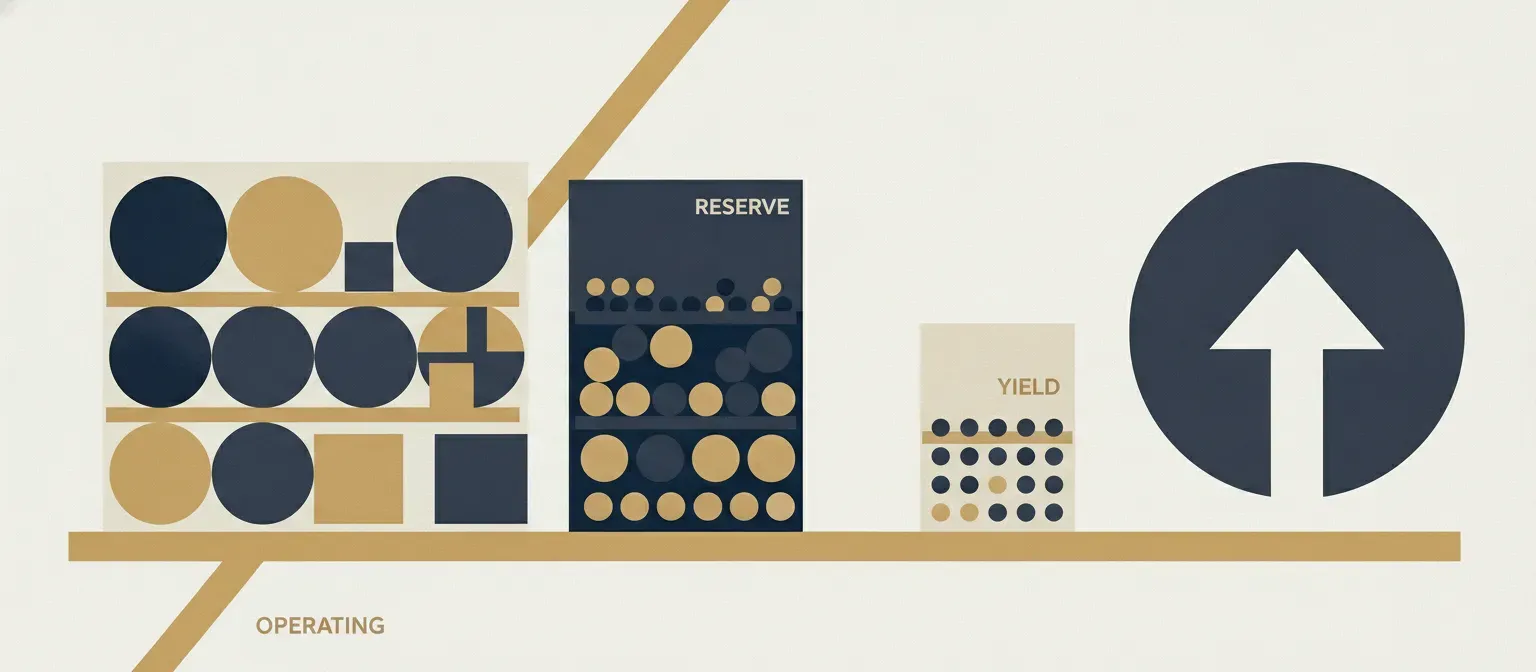
Actually, let me be fair to her. Plenty of idle cash should sit safe and liquid rather than chasing a moonshot. It can earn a modest yield in money market funds or T-bills while staying ready. Treasury teams sweep excess funds into interest-bearing accounts overnight for exactly this reason. The point is intent. Cash earning a deliberate yield is a player with a part to perform. Cash earning nothing because nobody looked is the silent section.
So how much cash is the right amount?
There is no single number, which is why this trips founders up. The right balance covers your obligations and your precautionary reserve, with a buffer sized to your uncertainty, and not a great deal more sitting idle without a reason. Keep the core ensemble. Hire the extra players when there is a part for them to play.
The discipline that matters is not a target balance. It is a habit: every dollar should have a thesis behind where it sits. Runway is a thesis. A funded hire is a thesis. A safe yield in a money market fund while you wait is a thesis. “We raised it and never moved it” is not a thesis. It is the absence of one, a section seated for no reason.
Excess cash = total cash − obligations due − precautionary reserve
Frequently asked questions
Is too much cash on the balance sheet ever a good sign?
Yes, when it is deliberate. A reserve held against real uncertainty, or surplus parked in safe, interest-bearing equivalents while you line up a high-return use, is good cash management. The good version always has a reason behind it. The worrying version is a balance that grows because nobody is making allocation decisions about it, players seated with no part to play.
Can too much cash on the balance sheet make a company a takeover target?
Yes. Companies with a big value of cash and cash equivalents become targets for acquisitions, because their excess cash helps a buyer finance the deal. Your own idle balance can effectively fund the purchase of your company. That alone is a reason to give every dollar a thesis.
What is the opportunity cost of holding too much cash?
It is the return you could have earned elsewhere. The opportunity cost of saving up cash is the return on equity the company could earn by investing in a new product, a new service, or expansion. Add the slow drag of inflation on dollars held flat, and idle cash carries a cost even though no line item shows it. It is the music you paid for and never heard.
What should we do with surplus cash on the balance sheet?
Give it a part. Deploy it into projects that earn a positive return, extend runway, or, at maturity, return it to shareholders through dividends or a buyback. If you are between uses, keep it liquid and earning a modest yield in money market funds or short-term Treasury bills. The mistake is leaving it idle by default, a paid section making no sound.
The stand: bring the whole ensemble in
Most people assume a large balance sheet is a sign of strength. A large idle balance actually tells you something more useful, which is whether you have a plan for the cash, so it is worth asking what it is telling you. A company should never let cash sit by accident. It should sit because you decided it should, for a reason you can say out loud. Every player on the stage has a part, or the player is not on the stage.
That is the whole idea behind CX Cash. You should know where the money is going, which dollars are deployed, which are idle, and what each one is earning. Pull your accounts into one view, see the surplus for what it is, and give every dollar a thesis instead of a hiding place.
Start with our consolidated cash-position tracker for Excel or Sheets to see your true balance in one place. Then join CX Cash. And if a founder you know is sitting on a silent pile of cash and calling it safety, share this with them so they can hear what the rest of the orchestra is missing.
More in Cash & Treasury Management

Cash Consolidation: Run Your Bank Accounts Like a Single Supply Line
Cash consolidation is treating every bank account as one supply line. Here is how to run your cash across multiple accounts like a commander who knows every depot.
Where to Park Idle Startup Cash: Choosing Your Anchorage Between Safe Harbor and Open Water
Where to park idle startup cash comes down to one choice: how far from safe harbor you anchor for a little more yield, knowing open water pays better and sinks faster.

Cash Position 101: The Schrödinger's Cat Sitting In Your Bank Accounts
Until you look at every account, your cash position is both alive and dead at once. Here is how the act of looking collapses it into one real number you can use.